
1. Prologue: Where Data Meets Design
Role: Principal Engineer, AR/VR Automation
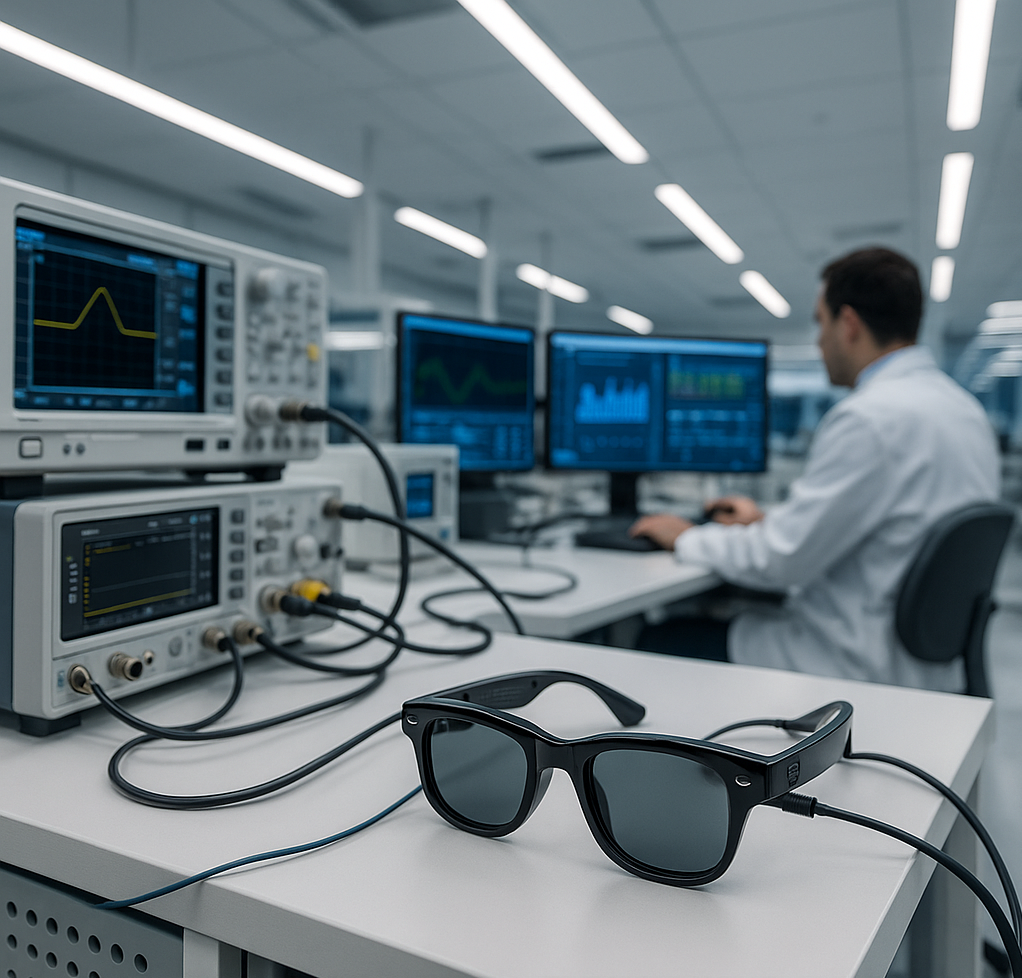
2. The Product: Ray‑Ban Meta Smart Glasses
The Second‑generation of smart glasses launched September 27, 2023. Featuring a 12 MP camera, Qualcomm Snapdragon AR1 Gen 1, integrated Meta AI voice assistant and livestreaming capabilities (Wikipedia).
Positioned at the intersection of fashion and consumer AI, blending minimalist Ray‑Ban design with advanced voice and camera tech (Vogue Business, Wikipedia).
In the state-of-the-art lab at Sunnyvale, I led testing development on prototypes of the next generation of wearable devices.
3. Challenge: Testing a low-powered AI Devices
Unique challenges included multiple versions of wearable form factors and development boards, real‑time voice and camera integrations, power consumption limitations, and cross‑team collaboration with hardware engineers.
The end goal being automation of end‑to‑end testing for image and video capture, streaming, voice commands, and Meta AI responses under real‑world conditions and day-of-use.
Providing data visualizations as performance feedback in a timely and reliably manner was key to the success of collaborating in a cutting edge environment.
4. The Framework: Automation That Bridged Software & Hardware
I led design of a Python‑based test harness that used serial and socket interfaces to interact with prototype hardware over RF and sensor interfaces.
We devised real‑time performance monitoring pipelines using kernel‑level tracing with Perfetto, capturing CPU/GPU events tied to system resource consumption (Wikipedia).
Our system gracefully handled aggregation from multiple endpoints using Python multi-threading techniques to cut measurement and visualization time dramatically.
5. Real Moments: Tweaking Data for Real‑World Use
- Implemented edge detection algorithms for precise event triggers—like the exact millisecond a user taps the touchpad or says "Hey Meta".
- Enabled robust synchronization between video capture, audio command response, and live streaming to Internal SDKs.
- The result: consistent, reliable test results replicable across teams.
6. From Old to New: Modernizing Legacy Tooling
- Migrated existing legacy Python scripts to modular, test‑driven code compatible across Linux/macOS prototypes.
- Improved maintainability, portability, and integration with version control and CI/CD pipelines—streamlining collaboration between software and hardware engineers.
7. Mentorship & Documentation
- Tutored junior engineers and cross‑functional stakeholders, demystifying low‑level tracing and automation techniques.
- Created in‑depth documentation on the testing architecture, smoothing onboarding and future expansion.
8. What I learned:
Building automation solutions isn’t just about code coverage...it’s about orchestrating real‑world hardware interactions reliably.